
Association of Facilitators Logo

How to Improve Facilitation Skills

Foundation Course in Facilitation Skills - A Remarkable Journey of Self Discovery: I signed up to the AoF’s Foundation Course in Facilitation Skills with a degree of anticipation but also trepidation. Would everyone have more experience than me? Was I a good facilitator or not? Over the five day course my eyes were truly opened to
2026-08-03T09:58:45+01:0010/06/2026|Categories: Articles|

Association of Facilitators 2023 Survey

In late 2023, we conducted a survey of facilitators in the UK, inviting responses from AoF membership and beyond, including from those who buy facilitation services. As well as some AoF-specific questions, we gathered insights into where facilitators work, fees charged, the impact of facilitator skills training and thoughts on the future of facilitation. Results and highlights are presented below. Thank you to all who took part in the survey. Highlights Most survey respondents were self-employed facilitators, with facilitation as

2026-08-04T16:47:48+01:0015/01/2024|Categories: Articles|

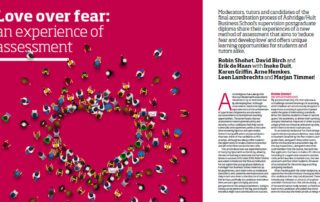
Love Over Fear: An Experience of Assessment

Moderators, tutors and candidates of the final accreditation process of Ashridge/Hult Business School’s supervision postgraduate diploma share their experiences of a new method of assessment that aims to ‘reduce fear and develop love’ and offers unique learning opportunities for students and tutors alike. Robin Shohet, David Birch and Erik de Haan with Ineke Duit, Karen Griffin, Arne Hemkes, Leen Lambrechts and Marjan Timmer

2026-07-23T11:06:32+01:0020/07/2019|Categories: Articles|

Leadership and Ego States – Prodigy or Pathology

This paper aims to provide some initial thinking into the expression of ego states in those considered “leaders” in both European and in non-European organisations. The paper is based on 30 years of consulting experience, and the examples given are therefore by way of case studies rather than on a statistically or methodologically based longitudinal sample. The conclusions should therefore be seen in this light.

2026-07-23T11:09:00+01:0010/08/2008|Categories: Articles|

Paul Barber: Becoming a Practitioner Researcher – Chapter 1

This chapter is designed to orientate you with the aims, style and content of this text. To encourage your reflection upon how Gestalt and holistic facilitation may be integrated in an approach to research, you will be invited to consider how what is on offer here compliments the world view that is gaining ascendance in the twenty-first century, which is suggested to be rapidly moving towards an ecologically informed holistic position. I also attempt to illuminate the core concepts that underpin this work. The definitions provided should not be taken to be truly definitive but rather as starting-points of your own research. We will also survey what holistic inquiry might focus upon, along with poetic aspects of inquiry in this vein. Hopefully, by the close of this chapter you will have begun to reflect upon your own world-view plus the bias and values you operate by.

2026-07-23T11:20:06+01:0021/06/2006|Categories: Articles|

Paul Barber: Becoming a Practitioner Researcher – Introduction

This text is designed to help you ‘think’ and ‘act’ in the manner of a qualitative researcher and will attempt to brainstorm you with options and challenges in a Zen-like way towards fresh insight. Indeed, Zen, ‘holistic research’ and Gestalt all encourage you to expand and raise your awareness, attend to everything, dismiss nothing and to establish a robust and intimate dialogue with what is unfolding in their immediate environment – right now. In this way, similar to a student of Zen you will also be encouraged to bracket-off belief and disbelief, to cultivate an open mind and to experientially inquire into what is before you. But first, I offer you a working definition of ‘Gestalt’ as a researching method...

2026-07-23T11:18:38+01:0020/06/2006|Categories: Articles|

Paul Barber: Group as Teacher

To motivate and develop personnel while fostering a co-operative team spirit presents a major challenge for business communities of the 21st Century (Waitley 1995; RSA 1995; Barber 2002). To this end this paper sets out to examine the gains and challenges of using a Gestalt informed peer-learning community within a commerciallybased master’s to nurture co-operation and personal development. On ancient maps in locations where danger was thought to exist the traveller was warned ‘there be dragons’. This account raises awareness to the organisational dragons that await Gestalt inspired change agents...

2026-05-06T09:08:48+01:0010/04/2006|Categories: Articles|
Go to Top